Wedding seating guide
Banquet Table Seating Chart: A Worked Plan for 24 Guests
A banquet table seating chart needs two decisions: which table each guest joins, and where they sit. At a long table, being assigned to the same table can still leave two friends several seats apart. Start with the venue's confirmed capacity, divide guests into comfortable groups, then check the immediate neighbors and people opposite each seat.
This fictional example seats 24 people at three separate rectangular tables of eight, including the couple. Each table has four places on each long side and none at the short ends. These are planning assumptions, not a claim that every rectangular table seats eight. Confirm your actual furniture and service arrangement before using the layout.
Count usable seats before placing names
Ask the venue to confirm seats with the actual chairs, place settings, table legs and decorations in place. Also check where staff will serve meals and how guests will enter and leave their seats.
| Table | Seats on one long side | Seats on the other side | End seats | Total |
|---|---|---|---|---|
| A | 4 | 4 | 0 | 8 |
| B | 4 | 4 | 0 | 8 |
| C | 4 | 4 | 0 | 8 |
| All tables | 12 | 12 | 0 | 24 |
There are no spare places. If an additional partner confirms attendance, the plan needs an approved extra seat or a different table arrangement. Moving names around does not create capacity. For a larger event, compare the alternatives in our 100-guest seating chart example.
Assign the three groups first
Our fictional couple, Iris and Joel, will share Table B with six friends. Table A holds a mixed family group; Table C brings together friends who know one another.
| Table | Guests | Count |
|---|---|---|
| A | Ana, Ben, Cora, Dev, Eli, Finn, Gia, Hana | 8 |
| B | Iris, Joel, Kai, Lina, Milo, Noor, Owen, Pia | 8 |
| C | Quinn, Rae, Sol, Tia, Uma, Vic, Wren, Zane | 8 |
Begin with the least flexible groupings. In Table A's example, Cora is a child who needs Dev beside her; Ana and Ben are partners, as are Eli and Finn. Gia and Hana are friends. We can preserve those connections without requiring all eight people to know everyone equally well.
For a separate couple's table, see the head table vs sweetheart table guide. Count Iris and Joel only once.
Place companions within the long table
Here is Table A viewed from above. Read each side from top to bottom; the diagram does not specify a compass direction or a service entrance.
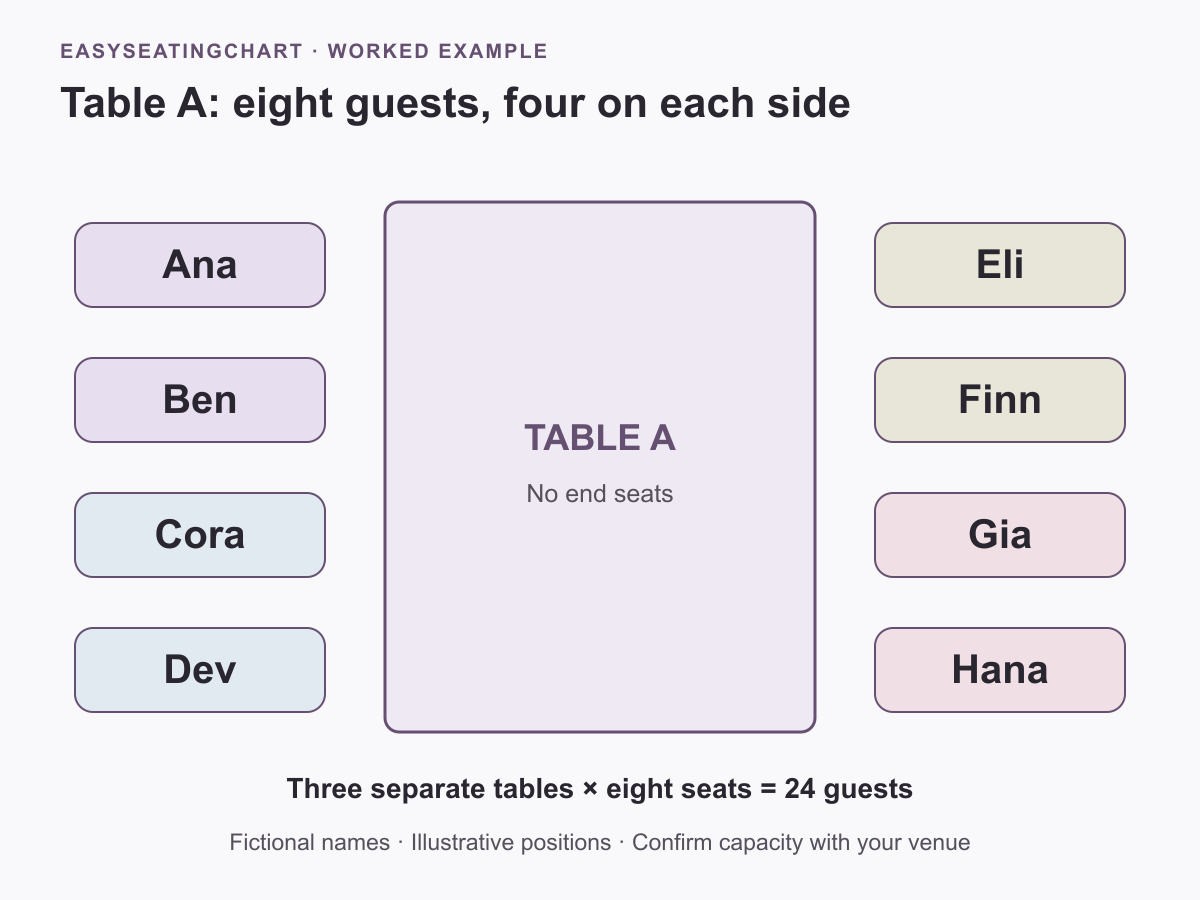
Original illustration with fictional names. Seat positions are illustrative, not a scaled floor plan.
Ana and Ben sit beside one another, as do Cora and Dev. Across the table, Eli sits beside Finn, and Gia sits beside Hana. Ana faces Eli; Ben faces Finn; Cora faces Gia; Dev faces Hana. That gives you eight specific places to review rather than a single label saying “family table.”
Ask whether the people opposite each other would enjoy talking, whether anyone needs a different position, and whether decorations interrupt sightlines. Do not place someone at a short end simply because they use a mobility aid; ask about their needs and agree on space with the venue.
Emily Post's guidance on seating solo guests recommends mixing singles and couples rather than isolating solo guests, while keeping couples at the same table. Adjacent seats are a separate decision. In this example, we choose neighboring places for the listed pairs; it is not a universal etiquette requirement.
Joining tables changes the plan
Three separate tables and one continuous banquet row are different layouts. Before joining tables, check capacity again. Any chairs originally placed at joining ends may lose their usable positions, and table legs or seams can affect the remaining places.
Our example has no end seats, so there are no end-seat assignments to remove. That still does not prove the joined layout works in your room. Confirm access, service and the actual seating positions with the venue.
For one continuous row, give guests more than “Long Table.” Use clearly marked sections and place cards if exact positions matter. Tell the coordinator which end is which on the staff plan. The table numbering guide explains how to keep labels consistent across the entrance display, table signs and venue copy.
Build the plan and check relationship rules
In the wedding seating chart maker, start with three separate rectangular tables, set their capacities to eight and add the 24 names. Assign each group and check that all 24 guests appear once, with nobody unseated. The tool distributes seat markers around the table; it does not reproduce the four-per-side arrangement shown above. Use the venue's floor plan and place cards to confirm exact physical positions.
If you use Together/Apart rules, remember their boundary: Together means the same table; Apart means different tables. Together does not guarantee adjacent chairs, and Apart does not create a particular distance between tables. Rules can be prepared free; applying them during auto-arrange requires a paid plan. Check the current plan details before relying on that feature.
For a continuous banquet row, two people could be far apart yet still share the same logical table. Review those positions manually. Never assume that a successful automatic arrangement has also checked hearing, physical access, table decorations or every unrecorded relationship.
Review before handing the plan to the venue
Check the headcount, each table's capacity and the companion positions first. Then walk through the room plan with the venue contact. Confirm that the staff copy, guest display and place cards use matching labels. Keep dietary and private relationship notes off the public seating chart, and give the coordinator one dated final version.
Frequently Asked Questions
How many banquet tables do I need for 24 guests?
Three tables with eight approved places each provide 24 seats. If the couple is additional to those 24 guests, you need 26 places. Confirm usable capacity with your venue rather than estimating from table shape alone.
Should guests sit at the ends of a banquet table?
Only if the venue approves those places for your furniture and layout. This example leaves both short ends empty. Joining tables can remove end positions that were usable when the tables stood separately.
Should couples sit beside or opposite each other?
Either can work. Start with their preferences and the surrounding conversation group. A child who needs a caregiver immediately beside them is a more specific constraint than two adults sharing a table.
Do I need place cards for a long table?
Use them when exact seats matter, such as for caregiver arrangements or a caterer's agreed meal-service plan. If guests choose seats within a section, explain that clearly.
Will a Together rule put guests next to each other?
No. In EasySeatingChart it keeps them at the same table when relationship rules are applied. Review and adjust the exact chairs yourself when neighboring seats matter.
Try the free wedding seating chart maker to turn your confirmed guest list and table capacities into a working plan.